Dieser nachfolgende Artikel ist ein Beitrag auf LinkedIn von Harald Buchmann vom 18. November 2026, der hier in voller Länge zitiert wird - von jemandem, der die Volksrepublik China erstmals vor einem halben Jahrhundert bereist hat, als Europäer. WS.
Heute sieht Buchmann die Rolle Europas so:
Because Europe all of a sudden is the remote sideline of world politics. Europeans may send some dignitaries and observers, but the decisions are taken by the Pacific rim countries of North and South America, East Asia and Oceania. India as an important neighbor of China is also of relevance, but few places are further from this new global center than Europe.
The probably most important speech of this week is the opening speech by Xi Jinping to the official APEC summit conference. This is because it’s become China’s tradition that Xi Jinping at the beginning of major national and international meetings starts by laying out a vision of the CPC leadership. Given how unpredictable and fast changing Western governments have become, and how consistently the CPC works on implementing its visions, few things have more impact on the future than the plans of the CPC. For a full text of Xi’s speech, we need to go to Chinese media, as Western media still don’t seem to realize or accept that speeches by Xi Jinping really matter. [1]
Short as it is, this is the most important speech of this year
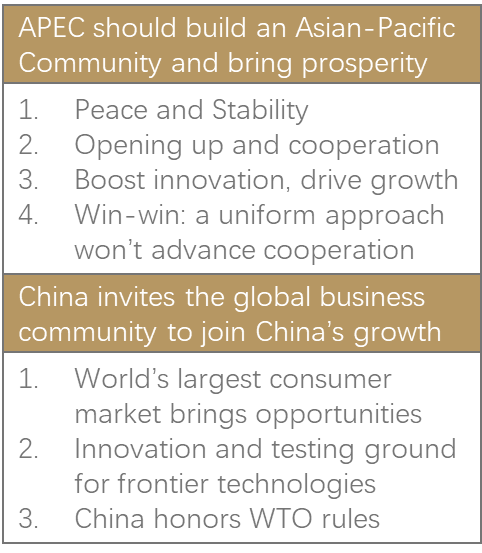
The speech consists of two main sections, the first is the global vision what APEC should become, the second what China offers for achieving this vision. APEC should bring prosperity by building an Asian Pacific Community, with four points on how prosperity is achieved. First, it needs peace and stability, war mongers must be kept out of the region, a clear nod towards militarization in Japan, various moves on and around China’s province Taiwan, but also towards the US, Russia, and NATO where some ideas of a NATO-Japan partnership had been floated in recent months. Second, prosperity needs opening up and cooperation, a rejection of protectionism and tariffs, mainly aimed at the US and Europe. Third, boosting innovation and driving growth, now this is a clear learning from the Chinese experience of socialist market economy. The state should by no means be passive and just protect the rules. Innovations should be actively boosted, and growth driven forward - by governments, that is obvious as Xi is speaking to heads of states, not the business community. And fourth, under the label win-win cooperation Xi emphasized the need for respecting diversity, quite as expected, and as necessary in the extremely diverse East Asian context.
Xi’s APEC opening speech in a nutshell, summarized by Harald Buchmann
What China offers is, first, a huge consumer market, but Xi Jinping can’t clarify how foreign brands can stay competitive in this massive market. Second, frontier technologies, a courageous statement, no longer hiding Chinese strength. Yes, frontier tech and high quality now come out of China, it is up to every region to figure out how to profit from that. And third, China adheres to the WTO rules. This is both a promise and an assertion, how much it is accurate is a very long topic, but China definitely isn’t worse than other WTO members in adherence to the agreed rules.
Further weeks and months will show if any of these initial statements really materialize and if any real change will come from this meeting.
As a last point we quickly compare this APEC summit to the last time China held the summit, 12 years ago, equally in the year of the horse, under very different circumstances. The first difference is emotional: China 2014 was still in awe and admiration of the US. Obama coming to China was a huge deal, and while some viewed Obama’s pivot to Asia already critical back then, many felt just honored that Obama gave China more attention than Bush and Clinton before him.
The second is economic: China was far weaker, and still smaller than the US economy measured in PPP GDP. It was a time of fast growth and exploding real estate prices, but China was still mainly the world’s work bench, with few high tech products coming out of China. BYD already existed, but was still famously laughed at by Elon Musk just two years earlier.
And politically China was in the consolidation phase after the transition from Hu Jintao to Xi Jinping. It was the first major international meeting hosted by China under Xi’s leadership and a big test for his ability to present China on the international stage. The effort was huge, an entire resort was newly built in northern Beijing, now still used as a hotel and among others for the bi-annual FOCAC forum between China and Africa. There was an outright APEC fever, with lots of publicity around the event, especially in Beijing.
This year, APEC is still a big topic, and widely discussed in China’s media, as well as a very big deal for Shenzhen, which hasn’t had major political events of this scale in the past, and is about to be upgraded from just business and high tech, to become a more comprehensive center of global influence. But nationally it feels like Chinese people have become much more used to leaders from all over the world visiting, including US presidents. Trump has visited China more than once, and after Covid virtually every large western country has sent their head of state at least once to China for a state visit. China doesn’t need the global affirmation anymore. The pride of being globally relevant is now slowly replaced with the feeling of the burden of responsibility that comes with being one of the if not the most important global power of our time.
Diplomatic insanity week in East Asia
This week is in fact, diplomatic insanity in East Asia, and that’s no exaggeration. Besides the major APEC summit on Wednesday and Thursday, there’s also been the ASEAN summit in Manila in the Philippines, which is an association of 11 South East Asian nations, covering a total population of almost 700 million people in its own right. ASEAN is a very interesting successful example of peace building, with an extrem diverse population, much greater than Europe in terms of number of languages and ethnicities, but also of religion with very conservative Muslim Indonesia, and very conservative Christian Philippines, and secular socialist Vietnam and Laos, and very rich Singapore but also very poor Cambodia. Yet ASEAN found a way to a free trade agreement by 1993, and so far the organization is thriving despite tensions between some memberstates.
And to ASEAN also Japan’s prime minister Takaichi and India’s prime minister Modi as well as US president Trump were present, as well as the Chinese prime minister Li Qiang and others who joined in their functions as dialogue partners of ASEAN.
The US used to opportunity for an informal QUAD meeting, yet another organization, with Japan, India, Australia and the US in one room debating how to contain China. Meanwhile several heads of states chose to arrive in Shenzhen two days early, and so Xi Jinping also had state-level bilateral meetings with Mexico, Chile, Peru, Vietnam, Canada,and Papua New Guinea within just two days, before APEC even started. And he met Russian president Putin bilaterally before meeting Trump, and then meeting both together again. You know the formula when 20 people meet how many combinations can you make? Definitely too many to get into the results of every meeting, but taken as a whole I think it’s a good week to realize how the center of the world is really shifting to the far East. And geopolitically this shift is incredibly important, a change unseen in centuries, to use a famous assessment of Chinese president Xi Jinping.
Because Europe all of a sudden is the remote sideline of world politics. Europeans may send some dignitaries and observers, but the the decisions are taken by the Pacific rim countries of North and South America, East Asia and Oceania. India as an important neighbor of China is also of relevance, but few places are further from this new global center than Europe. This is truly a symbol of the new emerging world order, a new world order we should be clear, that isn’t the scheming of some globalist oligarchs or Chinese communists, but a consequence of economic and political shifts that happen decentralized and everywhere differently but in parallel and at the same time.
Good morning! I wish to extend my welcome to you all, leaders of business communities of the Asia-Pacific. I am so delighted to meet you here in Shenzhen.
Shenzhen, on the shores of the South China Sea, embraces the surging winds and waves of the ocean. Over the past 40 years and more, Shenzhen has been a pioneer in China’s pursuit of reform and opening up. It has achieved a historic transformation from a small border town into an international metropolis, creating a miracle in the history of global development. There is so much people can draw from Shenzhen’s success.
Today, we find ourselves in a changing and turbulent world. Global growth lacks momentum, and unilateralism and protectionism are rampant. Still, global trade keeps growing against headwinds, and breakthroughs are being made in emerging technologies at a faster pace, exerting a profound impact on global development. What is going on with the world? What should we do in the Asia-Pacific? To open doors or close doors, work together or against each other, adapt to change or stick to old ways? These are hard questions of our times that we must answer.
As an ancient Chinese saying goes, all approaches should adapt to changing times to remain relevant. Born amid the waves of economic globalization, APEC has enabled the Asia-Pacific to steer the course of our times. This year, China is hosting APEC for the third time. We are ready to work with all other parties to forge ahead with resolve, jointly build an Asia-Pacific community, and bring prosperity for all in our region.
— To bring prosperity for all in the Asia-Pacific, we should uphold peace and stability. There can be no prosperity without security, and no security without stability. Thanks to the stable environment in our region over the past decades, the Asia-Pacific has maintained steady economic progress and become an important engine driving global growth. The more complex the external conditions become, the more important it is for us to uphold the postwar international order, and promote an equality-based and orderly multipolar world and economic globalization that is inclusive and brings benefit to all. It is even more important for us to resolve differences through dialogue and consultation, and overcome challenges through solidarity and cooperation. This is the way to cement the foundation for sustaining peace and stability in the Asia-Pacific.
— To bring prosperity for all in the Asia-Pacific, we should build bridges of opening up and cooperation. History tells us that opening doors brings progress while closing doors leaves one behind. We should firmly safeguard the WTO-centered, rules-based multilateral trading system, support free and open trade and investment, and keep global industrial and supply chains stable and unimpeded. We should work steadily toward a Free Trade Area of the Asia-Pacific, build a multidimensional connectivity network, enhance cooperation in areas such as digital transformation of trade, cross-border e-commerce, and smart customs, and deepen international cooperation on industrial and supply chains. All this will pave the way for greater economic integration in the Asia-Pacific.
— To bring prosperity for all in the Asia-Pacific, we should boost innovation to drive growth. Innovation is crucial for progress. APEC members have driven global scientific and technological innovation: Unicorn companies and large AI models have emerged in large numbers, and many innovations have empowered hundreds of trades and industries and reached millions of households. We should forge science, technology and innovation partnerships, deepen cooperation in the digital economy and AI, and promote green and low-carbon transition. By doing so, we can turn strengths in innovation into drivers of growth, and provide strong impetus for economic growth in the Asia-Pacific.
— To bring prosperity for all in the Asia-Pacific, we should expand our ways for mutual benefits and win-win outcomes. As the economies in our region differ in history, culture and stage of development, taking a uniform approach will not advance cooperation. We should remove trade and investment barriers to build an open Asia-Pacific economy. At the same time, we should promote development that is balanced and delivers benefits to all to ensure both efficiency and fairness. We should follow a people-centered development philosophy, strengthen economic and technical cooperation geared for developing economies, and deepen cooperation in transportation, public health, energy, food security, anti-corruption and other fields, so that development fruits are shared by all economies and all groups and communities.
The Asia-Pacific region is home to the world’s most important bay areas notable for their open and interconnected economies with positive spillover effects. Shenzhen, where we are now meeting, is part of the Guangdong-Hong Kong-Macao Greater Bay Area. China supports the establishment of a World Association for Bay Areas Economic Cooperation to deepen exchanges and interactions among bay areas from across the world. This will help us explore new ways for stronger economic cooperation in the Asia-Pacific.
Distinguished Guests,
Dear Friends,
This year marks the start of China’s 15th Five-Year Plan for economic and social development. China’s economy maintains a strong momentum of high-quality, innovation-driven growth, demonstrating great resilience and vitality. In the first three quarters, the Chinese economy grew by 4.6 percent. New quality productive forces are developing more quickly, a new pattern of development is being fostered at a faster pace, and green and low-carbon transition is steadily picking up speed. The 15th Five-Year Plan has gotten off to a good start. A blueprint for China’s development, the 15th Five-Year Plan also provides a list of opportunities for promoting economic growth in the Asia-Pacific and the wider world. Indeed, it is an invitation for cooperation China has sent to business communities from around the world.
— China will provide global business communities with a super-sized open market. China is the world’s second largest consumer market. It has the largest middle income group in the world and enormous potential for investment and consumption. From new energy vehicles to smart homes, from the silver economy to ice and snow tourism, every new growth area is creating new opportunities for businesses across the world. As China accelerates the development of a big, open market and increases import of quality products and services, more diverse demands will be unleashed. Recently, the ninth China International Import Expo was held in Shanghai. Many of you present today attended the Expo and found new cooperation opportunities. China will also continue to host "Export to China" series and other events to open efficient channels to help quality products from across the world enter the Chinese market.
— China will provide global business communities with a promising land for development. Innovation-driven growth and green transition are the keywords in observing China’s economy. From factory and farm robots, to autonomous driving and drone delivery, China is a super-sized innovation testing ground where frontier technologies are tested, improved and upgraded in real-world scenarios, and are then turned into high-quality growth drivers. China will step up efforts to build modernized industrial system, and deepen integration between technological and industrial innovation. It will support the transformation and upgrading of traditional industries, the expansion of emerging industries, and the forward-looking planning of industries of the future. This will generate strong impetus for technological innovation and growth of businesses around the world.
— China will provide global business communities with an environment that enables mutually reinforcing cooperation. In 2001, China hosted the APEC Economic Leaders’ Meeting for the first time and joined the World Trade Organization in the same year. Over the past 25 years, China has fully honored its WTO accession commitments. While pursuing its own development, China has shared opportunities with other countries and worked for common development. China has stood up to unilateralism and protectionism, and remained committed to true multilateralism, to upholding the multilateral trading system and WTO rules, and to advancing WTO reform; it has steadily brought stability and predictability to world economic growth and international trade and economic cooperation. No matter how the international landscape may evolve, China will not waver in its pursuit of win-win cooperation with all other countries. China stays firmly committed to high-quality Belt and Road cooperation, and welcomes the active participation of businesses from across the Asia-Pacific so that we can create growth opportunities and share the fruits of development together. China will not only cut tariffs and expand market access but also go a step further — we will carry out reform in challenging areas, such as rules, regulation and standards, in order to fully ensure market access and an accommodating operating environment in the manufacturing sector, to steadily expand opening up in the service sector, and to foster a more stable and more predictable first-class environment for companies from around the world to invest and do business in China.
Distinguished Guests,
Dear Friends,
The Asia-Pacific is our home; it is here we jointly pursue development and cooperation. Asia-Pacific business communities are pioneers of the global economy. I hope you will carry forward the entrepreneurial spirit, boldly pursue innovation and excellence, explore and expand opportunities for business cooperation, and make greater contributions to economic integration in the Asia-Pacific. You are more than welcome to continue to get actively involved in China’s reform and opening up and modernization drive, and share in the opportunities created by Chinese modernization.
Let us join hands to meet challenges facing development through opening up, generate momentum for growth through innovation, and pursue prosperity for all through cooperation. Let us work together to build an Asia-Pacific community and deliver a bright future for our region.
 DaybyDay ISSN 1860-2967